Google's AI family has another element: Gemini 4 Hydrogen. The periodic table is getting a surprisingly busy work calendar.
Announced on 12 November 2026, Hydrogen focuses on fast, everyday work, including coding and tasks carried out with tools. Google's announcement was updated on 16 November. It complements Carbon and Argon, which remain aimed at deeper investigations and demanding projects.
For someone choosing a model, the useful question is simple: can Hydrogen do this job well enough, without the extra wait and expense of Carbon? Across the OpenAI lineup, its everyday-work role overlaps most usefully with Sol and Terra. That is a comparison of intended jobs, not a claim of identical intelligence.
Hero: official Google Gemini 4 Hydrogen artwork. This is an explanation of published documentation and demonstrations, not a hands-on benchmark. Prices and availability checked on 16 November 2026.
What kind of model is Hydrogen?
A model is the AI system underneath an app. A reasoning model can spend extra processing effort working through a problem before answering. Hydrogen is also multimodal: Google's specifications list text, images, audio, video and PDFs as inputs, with text as the output.
You could therefore supply a document and ask questions about it, or provide a screenshot alongside an explanation of what looks wrong. Generating a finished picture or soundtrack requires other tools or models; understanding an image is a different capability.
Google also describes Hydrogen as agentic. In plain language, it can participate in a sequence of actions through tools: inspect information, make a change, check the result and continue. The surrounding app determines which tools and permissions are available. Merely naming a spreadsheet in chat does not grant access to it. Thankfully, the office stationery cupboard remains outside its jurisdiction.
The model card says Hydrogen is adapted from Carbon. That establishes a relationship; it does not establish that the two behave identically.
What would you actually use it for?
Think of tasks with a clear result you can inspect. Here are three suggested starting points, rather than claims about results we have tested:
- Compare information you already have. Give it three product specifications and your requirements. Ask for a comparison, with missing information marked clearly instead of guessed.
- Turn rough material into a useful document. Supply meeting notes and ask for a short brief, open questions and an action list. Check that it has not promoted somebody's vague suggestion into a legally binding promise to buy biscuits.
- Iterate on a small website. In an app with suitable development tools, ask for a simple page, then request clearer labels or a more readable mobile layout. Check the actual page and its buttons before relying on it.
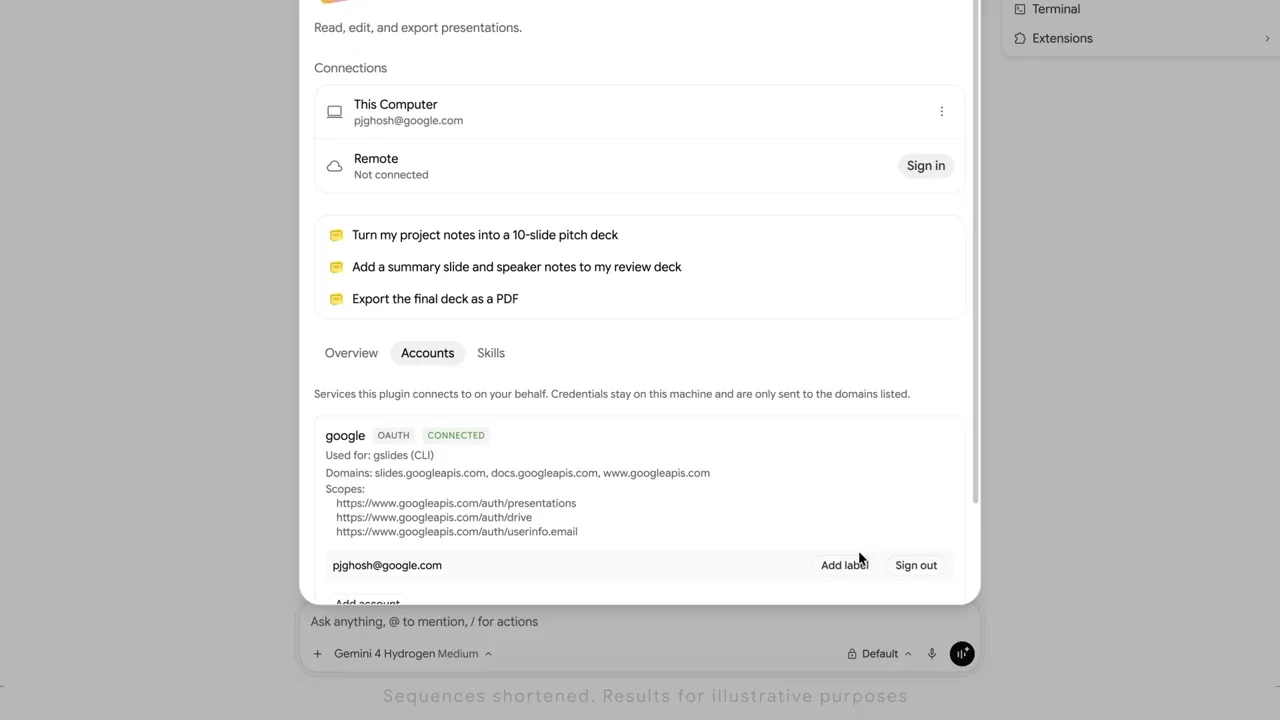
Google's launch demonstrations include taking a YouTube keynote and a design template into Antigravity, creating a Google Slides presentation and checking the slide layouts. That illustrates the model working with an application, rather than producing a presentation file through text generation alone. It is Google's example, not a TechDecode test.
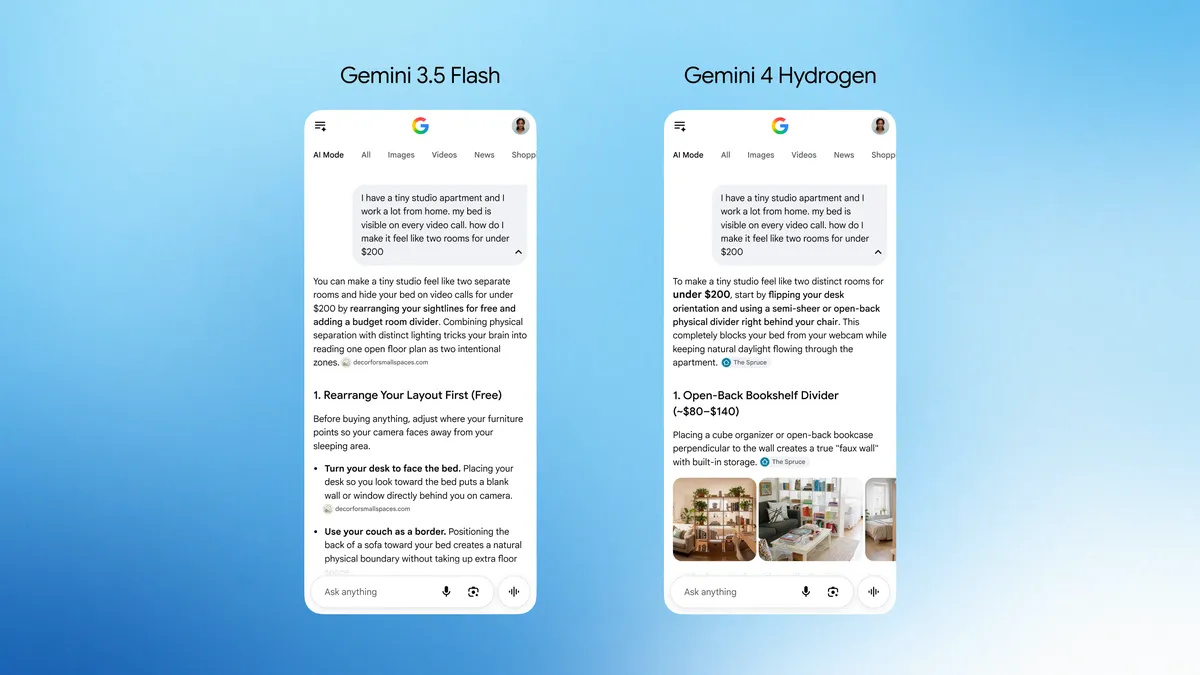
The release also brings Hydrogen into Search. Google's examples show more visual responses to questions such as planning an apartment renovation. A polished response can help you explore a subject; its appearance does not verify the underlying advice.
Where does it fit beside Carbon and Argon?
Google's documentation describes overlapping roles. Use these as starting points for choosing a model, rather than a medal ceremony.
On a narrow screen, swipe horizontally to read the full tables.
| Model | Main emphasis | A useful starting job |
|---|---|---|
| Gemini 4 Hydrogen | Responsive execution and everyday tool-assisted work. | Revise a document, build a small web page or work through routine code changes. |
| Gemini 4 Argon | Advanced work with lower token use and faster responses than Carbon. | A substantial software feature or a complex analysis with several connected steps. |
| Gemini 4 Carbon | Google's strongest reasoning model, spending more effort exploring and verifying difficult problems. | Investigate a stubborn software failure or weigh a difficult system design. |
The distinctions come from Google's Hydrogen guidance, Argon documentation and Carbon documentation. Our Carbon explainer and Argon article cover those models in more detail.
Hydrogen also occupies territory previously served by Gemini 3.8 Flash: Google recommends it as an upgrade. Gemini 3.5 Flash-Lite retains a separate role for very fast, inexpensive tasks such as sorting large numbers of messages into categories. Hydrogen is not Google's cheapest model.
There is even a way for models to share the work. In Google's development app Antigravity, Orchestrator can switch models during a single session. Carbon might plan a difficult change, Hydrogen could implement and test it, and Carbon could return if the work gets stuck. Think of a colleague handing over a clear brief, then coming back when the printer starts speaking Latin.
The Carbon version of Orchestrator requires Google AI Ultra; the Argon version is available to paid Pro and Ultra subscribers. Hydrogen itself is available in Antigravity on those paid plans. This access is separate from the Gemini chat app.
How does it compare with Astra, Sol, Terra and Luna?
The closest useful comparison is by job, not by matching names or assuming one company's score predicts another company's result.
- GPT-6 Astra: OpenAI's most capable model for demanding work. Its role overlaps more with Carbon's difficult-problem focus than Hydrogen's everyday emphasis.
- GPT-6.1 Sol: A model for complex coding, computer use and professional work. This is a natural comparison when you want a capable assistant for varied work rather than one narrow task.
- GPT-6.1 Terra: A fast, efficient model for visual reasoning, computer use and writing. Its emphasis on efficient execution makes it another relevant Hydrogen comparison.
- GPT-6 Luna: OpenAI's fast, inexpensive option for focused tasks. It is relevant when the request is tightly defined and repeated frequently.
Those are editorial comparisons based on the documented roles. We have not run a controlled cross-provider test. Hydrogen could be the more convenient choice for one workflow and a poor fit for another, particularly if the application lacks the tool you need.
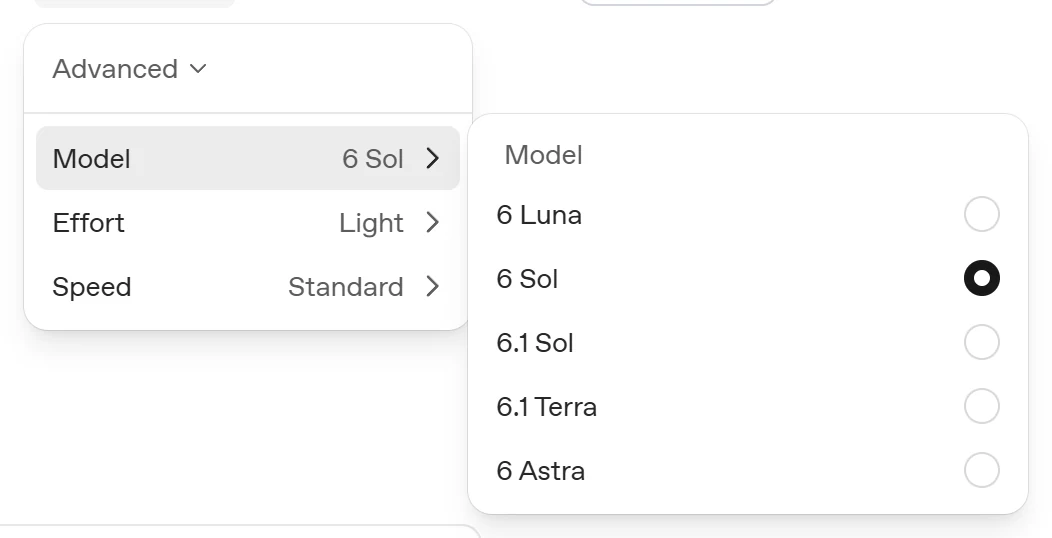
If you already use OpenAI, our Astra versus Sol comparison and Terra explainer provide more background. Before changing services, try the same representative task in each and compare the corrections you have to make. A convincing first paragraph is a surprisingly low bar.
Can you use Hydrogen free?
Yes, with conditions. For personal Google accounts, the Gemini app's model guide says free users access Hydrogen through Auto selection when a prompt needs more reasoning. Most prompts use Flash-Lite. Turning Auto off leaves free users with Flash-Lite, rather than a manual Hydrogen choice.
Google AI Plus, Pro and Ultra include Hydrogen in chat; Pro and Ultra also include it in Tasks. Limits apply, and work or school accounts depend on their Workspace licence. Check Google's plans page for local subscription pricing and eligibility.
Separately, Google AI Studio and the Gemini API offer free and paid Hydrogen tiers. An API lets software send requests directly to the model. Its usage bill is a different thing from a monthly chat subscription.
What does it cost through the API?
API billing counts tokens, small units of text or other data. Input is the material sent to the model; output billing also includes reasoning tokens used while it works. A short visible answer can therefore involve more billable work than you see.
These are Standard API prices in US dollars per million tokens, using ordinary uncached input, checked on 16 November 2026. For the OpenAI rows, the displayed rates apply up to 272,000 input tokens per request.
| Model | Input | Output |
|---|---|---|
| Gemini 4 Hydrogen | $1.50 | $7.50 |
| Gemini 4 Carbon / Argon, through 30 November 2026 | $2.00 | $10.00 |
| Gemini 4 Carbon / Argon, from 1 December 2026 | $4.00 | $20.00 |
| Gemini 3.8 Flash, through 31 December 2026 | $0.75 | $3.75 |
| GPT-6 Astra | $10.00 | $50.00 |
| GPT-6.1 Sol | $2.00 | $10.00 |
| GPT-6.1 Terra | $1.00 | $5.00 |
| GPT-6 Luna | $0.10 | $0.50 |
Sources: Google's API pricing and OpenAI's API pricing. Flash rises to $1.50 input and $7.50 output from 1 January 2027. For these OpenAI models, requests exceeding 272,000 input tokens charge twice the input rate and 1.5 times the output rate across the entire request. Caching, other processing tiers and tool charges can change the bill.
For a deliberately equal-token illustration, 200,000 input tokens plus 20,000 billed output tokens would cost $0.45 with Hydrogen. Carbon would cost $0.60 at its introductory rates, or $1.20 from December. This is arithmetic, not a prediction of what a particular task will consume.
Hydrogen sits between Terra and Sol on these per-token prices. It currently costs twice as much per token as Flash's introductory offer. However, models may need different amounts of thinking, retries and tool use to finish the same job. Compare the cost of acceptable results, not just the smallest number on the menu.
Choose the thinking level, then check the answer
Hydrogen's API offers low, medium, high and xhigh thinking levels, with high as its default. Google's guidance reserves xhigh for difficult problems where high falls short: extra thinking can add time and token use, and can overcomplicate simple requests.
The Gemini app has different controls: Low, Medium and High, defaulting to Low if you do not choose one. A documentation screenshot from one product is not a map of every other product.
An optional technical detail: Hydrogen's roughly one-million-token context is a shared space for the input, thinking and output. It is a working allowance, not unlimited memory or a promise to remember every detail perfectly.
For a first trial, try a document you can personally check:
Summarise these notes in five bullets. List decisions separately from suggestions, identify missing information, and show the source passage for each action item. Do not invent owners or deadlines.
Read the cited passages. Check one detail you expect it to miss. If the result is wrong, identify whether the missing ingredient is a clearer request, better source material, an unavailable tool or a genuinely harder reasoning problem. Our prompt-writing guide can help with the first two.
Google's model card still lists factual mistakes as a limitation and gives a March 2026 knowledge cutoff. Current information needs fresh sources or suitable search tools. More thinking does not manufacture evidence.
Our practical recommendation is to try Hydrogen on ordinary work you can verify, then consider Argon or Carbon when a difficult task justifies another attempt. Keep whichever produces a dependable result with a tolerable amount of supervision. Ideally, less supervision than the office printer.